
Duct bank under a Bridge Street medical office pad
Post-paving TI cannot trench across the parking aisle to reach switchgear. HDD links vaults with pits offset from striping.
Las Vegas, NM · San Miguel County
Steerable HDD under Las Vegas gravel drives, Bridge Street pads, and NMDOT I-25 relocations — mud programs for Gallinas River alluvium, adobe clay, and Meadow City foothill corridors.
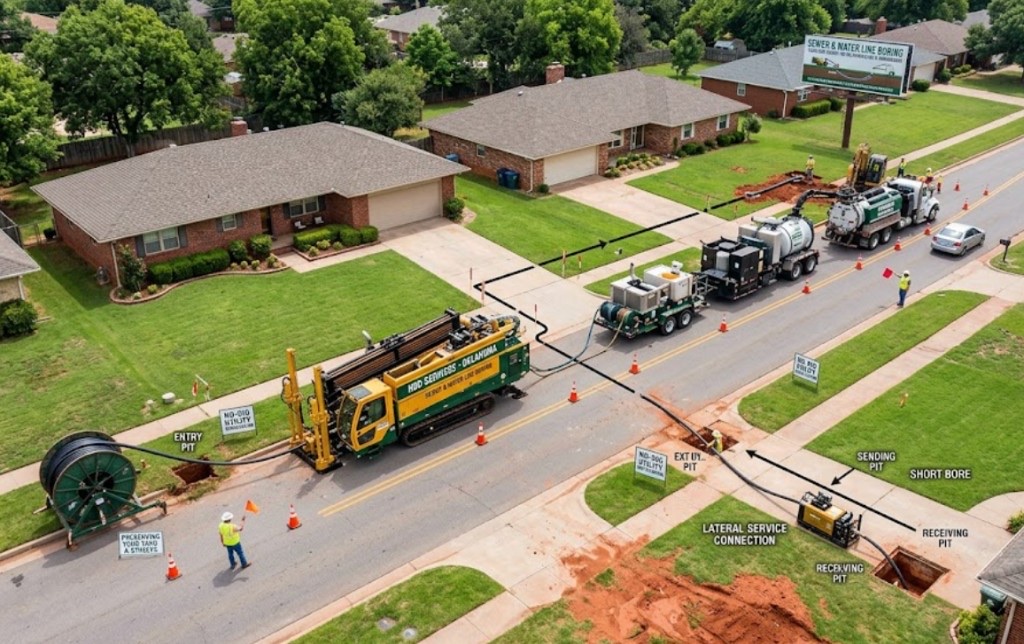
Horizontal directional drilling in Las Vegas serves East Las Vegas owners who need sewer or water replaced under adobe courtyard walls and gravel drives without losing valley landscaping to open-cut restoration. GCs on Bridge Street and I-25 TI schedules pull duct bank between vaults after asphalt is set — parking stays open while conduit crosses under the pad.
San Miguel County's shallow stack — PNM secondary, Comcast fiber, city water, gas, and irrigation laterals — means Las Vegas HDD starts with New Mexico 811 and hand holes at paint conflicts. Directional Boring New Mexico matches rig class to Gallinas alluvium versus volcanic tuff mesa infill, not a Santa Fe Cerrillos template alone.
Directional boring in Las Vegas on I-25 and US-84 frontage layers NMDOT District 4 MOT, city ROW fees, and Gallinas River flood-control awareness on standard locate rules. NMHU campus growth adds night-window bores when daytime traffic on Bridge cannot stop.
Real San Miguel County angles — not generic statewide copy.
Post-paving TI cannot trench across the parking aisle to reach switchgear. HDD links vaults with pits offset from striping.
Failed lateral under rock mulch and stucco walls — steerable bore from meter to cleanout preserves the courtyard open-cut would remove.
NMDOT widening stacks relocations under state ROW. HDD narrows lane closure versus open trench; night windows scoped before booking.
Campus ROW with shallow congestion — compact rig for short vault shot with pothole program on every conflict.
Las Vegas HDD crews confirm survey and locate paint — two business days minimum on 811, longer when NMDOT or flood-control controls the ROW. Pits are shored for alluvium or adobe clay; mud weight rises near Gallinas River banks. Pilot, ream, and pullback are monitored for buoyancy on long HDPE pulls through spring-runoff-softened fill.
San Miguel County valley floors carry Gallinas River alluvium, adobe clay, and volcanic tuff mesa infill — foothill cobble belts and I-25 grading debris change mud programs block to block.
Las Vegas bores encounter Gallinas River alluvium and adobe clay on flat valley parcels with volcanic tuff lenses near Meadow City foothill roads. Montezuma approach carries cobble fill with seasonal groundwater after monsoon storms — buoyancy management matters on longer HDPE pulls. I-25 interchange grading can hide debris that potholing catches before pits are sized. We do not assume Santa Fe Cerrillos sand models apply on Gallinas valley fill.
High-elevation cold, spring wind, and summer monsoons drive Las Vegas bore schedules — Gallinas River runoff and freeze-thaw at 6,400 feet are built into quotes.
Winter cold and freeze-thaw at 6,400 feet affect crew safety and pit stability on exposed I-25 pads. Spring Gallinas runoff and monsoon cloudbursts soften valley ROW from March through September — entry pit work may wait for dry windows. High-elevation wind complicates cage handling on open highway sites. Irrigation season raises shallow groundwater on agricultural-adjacent bores — we schedule around known saturation patterns.
City of Las Vegas Community Development, San Miguel County ROW, NMDOT District 4 on I-25 and US-84, Gallinas River flood-control easements, and PNM agreements apply on many alignments.
City of Las Vegas Community Development governs street cuts, driveway removals, and drainage work along municipal ROW. San Miguel County rules apply on unincorporated parcels toward Mora and the agricultural fringe. NMDOT District 4 controls I-25, US-84, and state highway bores — MOT plans are common on Bridge Street frontage. Gallinas River flood-control easements add coordination beyond standard 811. PNM agreements govern electric-adjacent paths in northern New Mexico.
Open-cut on East Las Vegas hardscape or Bridge Street retail pads often costs more in gravel mulch and business interruption than the bore. HDD wins on I-25 congestion and river easements — open valley acreage may still favor trench on price.
Footage, diameter, caliche versus rock, dewatering, traffic control, permit fees, utility density, and rig class — quoted as drivers, not a menu price.
You share plans or describe the problem; we confirm alignment, depth, access, and which trenchless method fits New Mexico soils.
New Mexico 811 ticket filed; two business days minimum before pits open unless your permit path differs. We pothole where marks conflict.
Bore plan, NMDOT or city ROW permits, railroad agreements, and crossing engineering when the path leaves private property.
Compact spread for tight Santa Fe lots; larger HDD for I-25 or I-40 relocations — matched to length and diameter.
Steered pilot on design line, ream passes sized for your pipe or casing, fluid program tuned for caliche or adobe clay.
HDPE fusion, steel casing, or multi-duct bundle pulled with tension and bend-radius monitoring.
Pressure test, mandrel, or survey records for owners, inspectors, and operators as spec requires.
Compact pits, replace gravel or hardscape per scope, leave 811 ticket and locate map in your project file.
Las Vegas HDD follows length, diameter, Gallinas alluvium or adobe clay, utility density, flood easements, and restoration — not a flat rate. East Las Vegas lateral, Bridge duct, and I-25 crossing use different spreads. Send alignment for a free estimate.
Yes — mud programs adjust for alluvium, adobe clay, and volcanic tuff. Gallinas River flood stages and monsoon groundwater need extra planning on long pulls.
Two business days minimum after 811 filing. Older Bridge Street corridors often need remark tickets and potholes at abandoned lines.
Yes — daily mobilization across San Miguel County; permitting shifts between city, county, and irrigation districts.
Often yes with offset pits and steerable path — tie-in cuts flagged in quote.
24/7 — Emergency dispatch statewide. Tell us entry, exit, pipe size, and county — a bore specialist calls back with cost drivers, not a flat rate.
Scope your alignment
Step 1 of 2 — path, pipe, and city first